
Shrimp farming has long been a lucrative industry, but it faces challenges related to inefficiencies and waste. Artificial intelligence (AI) is now emerging as a crucial driver of efficiency and sustainability for the industry.
By using AI for monitoring and management, farmers can optimise feeding protocols and maintain the health of shrimp – reducing waste, improving feed conversion ratios and increasing production in a more sustainable way.
Production challenges facing the industry
Poor feeding protocols and inadequate attention to environmental factors can have a detrimental effect on shrimp harvests. Mismanagement of operations can lead to declines in shrimp health. Inefficient use of feed and poor water quality can cause highly turbid conditions, which require frequent water changes.
AI technology offers significant promise in addressing these challenges through real-time observations and data, providing farmers with a powerful new tool to optimise their operations.
How the system works
In order to harness the full potential of AI technology, the system must be capable of monitoring production environments, feeding, shrimp behaviour and other key factors. It must also be able to connect observations with shrimp health.
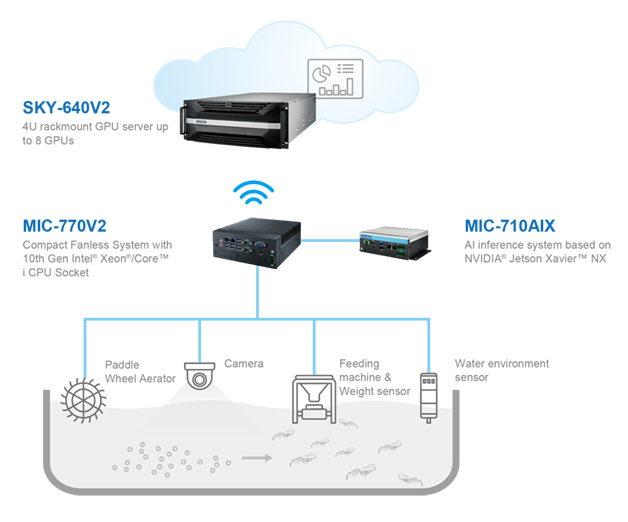
The AI powered shrimp farming system consists of a PC gateway that acquires data from a range of sensors such as cameras, weight sensors and water quality sensors. This data is then used to control the paddle wheel aerator and feeding machine. The paddle wheel aerator regulates the water aeration, while the feeding machine controls the release of feed for the shrimp.
An MIC-770V2 unit is embedded with a 10th Gen Intel® Core™ i CPU to support data acquisition and processing. It can connect to both wired and wireless networks to communicate with the MIC-710AIX edge AI system and SKY-640V2 backend server.
The MIC-710AIX AI system is powered by the NVIDIA Jetson Xavier NX SoM and is responsible for collecting sensor data from the MIC-770V2. The feeding and shrimp growth AI models are processed on the Xavier NX CUDA cores. The metadata generated by the AI models is then sent back to the MIC-770V2 via the MIC-710AIX AI inference unit, which adjusts the paddle wheel aerator and feeding machine to maintain optimal conditions for the shrimp. The SKY-640V2 GPU server gathers data from various shrimp pools and uses it to retrain the AI system for more precise and efficient management.
Benefits of AI
Shrimp farmers can reap numerous benefits by using AI-powered monitoring and control in their operations. With real-time monitoring of shrimp populations, farmers can make informed decisions about feeding protocols, leading to improved feed conversion ratios and reduced waste. This, in turn, can lead to a reduced environmental impact. Additionally, accumulated data can be stored and analysed to gain insights into how shrimp populations are performing over time, and how farmers can improve long-term production resilience.
With this advanced technology, shrimp farming can become a more sustainable and profitable industry.
ESIS is the leading supplier of outstanding industrial electronic equipment in the Australian market since 1971. Check out our exclusive range of Fanless PCs, Industrial PCs (IPC solutions), Rugged Tablets, HMIs, Panel PCs and other electronic components. Our products are certified and made with high-quality custom materials for accurate results. Contact us for a detailed product catalogue or to share your queries.
Article courtesy of Advantech.


Hi
May I know if this may work for indoor shrimp farm with Biofloc?
My name is Suresh Chand from Fiji islands in South Pacific. We are farming king prawns in 1 acre in ground ponds. we have been doing things and learning on trial and error basis.
I have been doing bit of research on shrimp production to increase production and reduce cost.
I’m very interested in your system setup and want to learn and do something similar in Fiji to increase productivity.
im Also very keen in introducing technology to support production
we have farm which has very easy access to sea water. Basically we channel sea water into our farms
But without proper knowledge and training on water management and feeding techniques
Seems our mortality rate is very high
Our yield at harvest is around 2500kg per acre pond
I’m very sure we are supposed to at least harvest around 8-10,000kg per harvest per pond if not more
Please advice if you can support and give some advice
I’m also willing to visit and get trained for few weeks with your good office staff if that’s an option. Purchase all equipment pay for your staff to come to Fiji and help in setup and training for 1 year
Looking forward for your favourable
Hi Suresh, thanks for your detailed comment. Note that we are not shrimp farmers and we don’t have industry specific knowledge to that particular industry. But if this AI based system is of interest, I can find out more about the details of how the system worked for that application and let you know what’s involved. Please email us for more information.