
Advantech’s MIC-720 industrial-edge AI platform is using image detection to transform traffic flow in the hustle and bustle of Taiwan’s capital city.
Getting stuck at a red light on an otherwise empty street is a scenario familiar to people who drive at night on Taipei’s major roads. Traffic lights are set to timers adjusted for peak daylight hours to accommodate the city’s usual busy traffic and provide enough time for pedestrians to safely cross wide roads.
In an effort to enhance traffic efficiency at all hours, Taipei City introduced an AI smart traffic light control system. This system, integrated by THI Consultants Inc, combines street cameras with Advantech’s MIC-720 industrial-edge AI host, and Yuan High-Tech’s AI algorithm. It provides flexible traffic light adjustments based on actual traffic to optimise efficiency.


How the system works
Surveillance cameras are equipped with AI image detection that collects data on the status of cars and pedestrians. This system uploads images in real-time to the MIC-720. Next, the MIC-720 conducts AI image detection and calculates the positions of people and cars. When necessary, the system can prolong green lights and activate responsive signals to adjust traffic lights in real-time.
There are three justifications for traffic light adjustment:
- When arterial road lights are green and there are pedestrians or vehicles waiting at intersections, the timer is adjusted to its minimum value.
- When side road lights are green and there is traffic on it, the green light time is extended.
- When there is no traffic on side roads, their green lights are deactivated to maximise efficiency on arterial roads, which benefit from green wave.
In order to ensure the precision of AI image recognition algorithms, Yuan High-Tech adjusted the AI’s label and item recognition capacities. The adjustment, made in the initial stages of system development, yielded algorithm training and model construction adaptable to high-contrast scenarios found at night or on sunny days.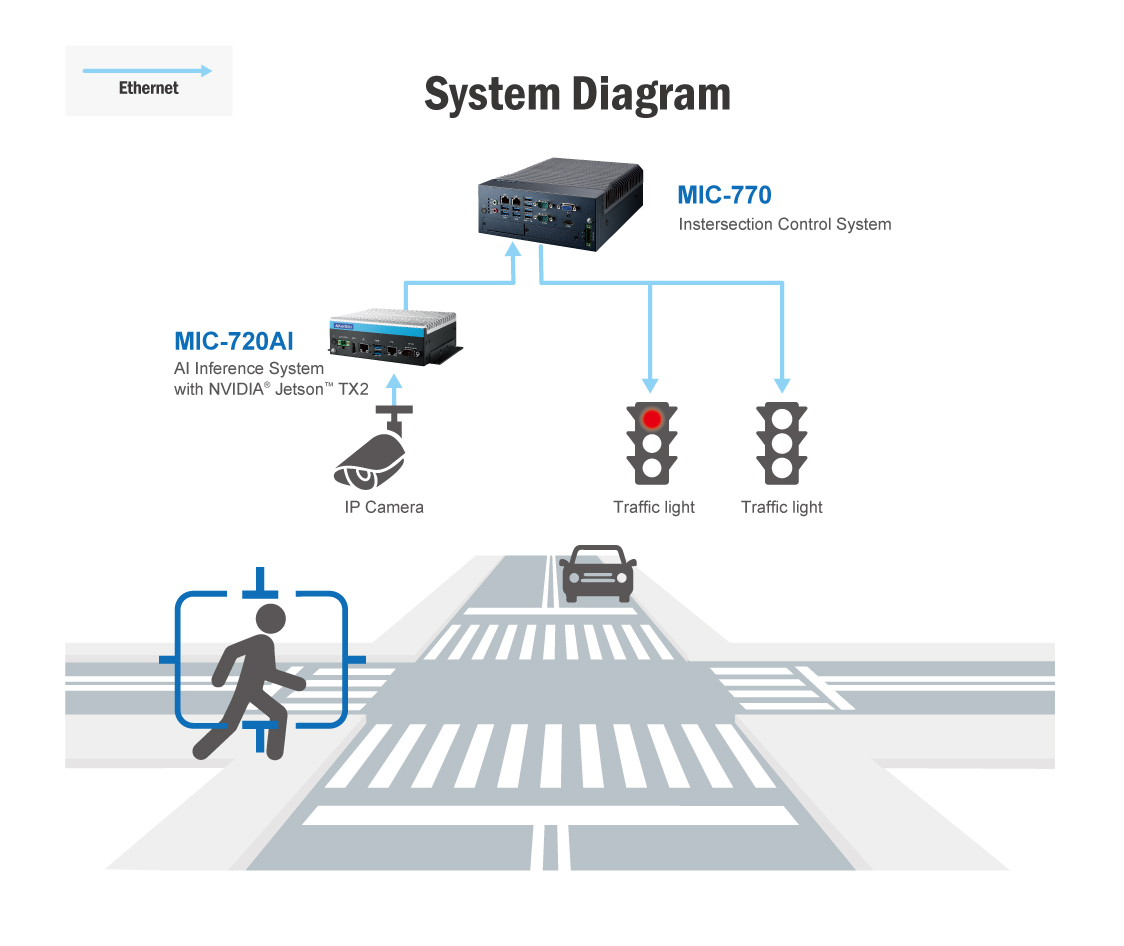
This AI smart traffic signal control system can change specific traffic lights according to traffic flow, giving traffic on side roads enough time to pass while increasing arterial road green light time when side roads are empty. It enhances traffic flows for arterial roads during the day, while reducing waiting times at red lights at night.
Improved wait times signal a great outcome
Statistical analysis conducted after the implementation of the AI smart traffic signal control system suggests a stark improvement in wait times. The average wait time for a vehicle across different time spans has decreased by between 15 and 78%. Night wait times at red lights on arterial roads decreased by 35% and arterial roads green light periods increased by between 7 and 79%.
Reducing the wait time at red lights corresponded with a reduction in vehicle idle time and fuel consumption. When converted into an energy-saving and carbon-reducing data, this system reduces emissions by around 23 tonnes every year and results in an annual economic benefits of around TWD 1.83 million.
Overall, the system reduces traffic jams and increases road capacity.
Why Advantech’s edge AI system?
Due to latency in data transmission, AI smart signal control systems use an edge computing structure in which hardware plays a significant role. This hardware must meet three criteria.
- First, it must deliver high-performance to conduct stream decoding and image processing.
- Second, as the success of image recognition is easily affected by environment changes, this hardware must wield enough processing power to facilitate deep learning and deduction.
- Finally, its hardware must be capable of withstanding the harsh environmental conditions found on street corners, like high temperatures, precipitation and humidity.
Advantech’s MIC-720AI is equipped with NVIDIA® Jetson™ Tegra X2. This solution’s elegant fanless design features built-in image recognition modules and supports deep learning models and processes. Its wide range operating temperature makes it ideal for outdoor applications that require AI edge computing. By simply integrating a signal control system, the MIC-720AI can be upgraded to an AI solution.
At ESIS Industrial Electronics, we offer a range of solutions to meet your industrial user interface needs. Whether you require a rugged, high-quality display, a powerful integrated computing platform or a programmable interface for direct PLC integration, we have the right equipment to ensure your operations run smoothly and efficiently.
For more information, visit www.esis.com.au or contact our team to discuss your specific requirements.
Article courtesy of Advantech.


