
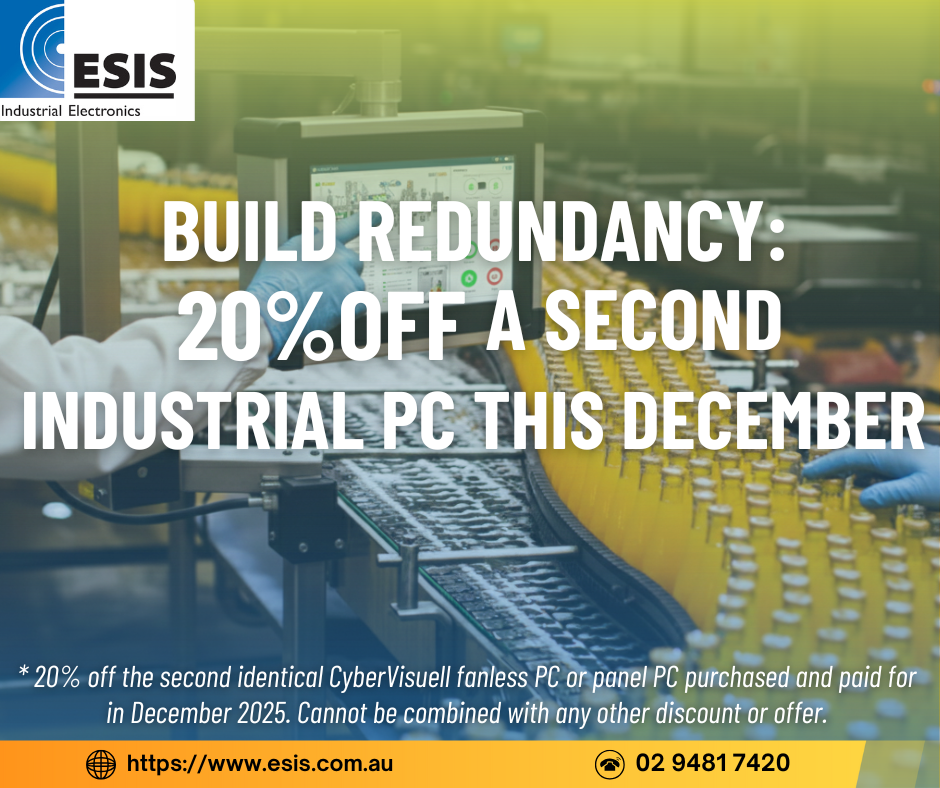
At ESIS, when you buy a CyberVisuell fanless PC or panel PC this December, we’re offering 20% off a second one.* It’s all about helping our customers build in critical redundancy, which can be a real lifesaver for business operations. Just ask the operator of a beer bottling line in Adelaide, which stopped producing when a single industrial PC failed.
The PC was 12 years old. The hardware was obsolete. The operating system was no longer supported. Engineers couldn’t find replacement parts anywhere.
They sent the failed system to us. We analysed it, built a custom replacement, duplicated the hard drive, worked through driver compatibility issues and got it running again.
But the whole process took several weeks. During that time, the bottling line ran at reduced capacity. The company lost weeks of production revenue, paid emergency engineering callout fees and absorbed the cost of our custom rebuild work.
All of this could have been avoided if they’d bought a second identical PC when they purchased the first one.
The real cost of single points of failure
Here’s what happens when a critical industrial PC fails without a backup ready.
Engineers rush to site. They identify that the PC has failed but can’t fix it. They start desperately calling suppliers trying to source replacement hardware that matches the original specification. If the system is more than a few years old, that hardware probably doesn’t exist anymore.
Even if they find compatible hardware, they are still facing driver issues, chipset changes, and compatibility problems with proprietary software or specialised add-on cards.
The bottling line case isn’t unusual. We’ve seen similar situations in water treatment facilities, mining operations, and utilities infrastructure.
A $3,000 PC failure can halt a $3 million project.
The question most customers never ask
When someone contacts us about an industrial PC, we ask a simple question:
“What would happen at your site if this PC fails?”
Some customers haven’t worked through the answer. They are focused on finding the right specification at the lowest reasonable cost. They are thinking about the upfront purchase, not what happens in six months or six years when the system goes down.
Others, mostly experienced engineers working on infrastructure or large industrial projects, treat redundancy as a design requirement, not an optional extra. The cost of an additional PC is relatively small compared to the project size, and the cost of outages is significant enough that redundancy isn’t negotiable.
The experienced engineers at ESIS think this way too. They consider a PC failure won’t just stop one machine – it cascades through the whole operation. So they calculate lost production. Call-out fees. Damaged reputation. Project delays. Safety risks. Then they help customers build redundancy into the design from the outset.
Why redundancy is more important than ever
The risk landscape has also shifted. Cyber threats targeting industrial systems have increased. Supply chains are increasingly fragile, and component shortages are worsening. Hardware obsolescence cycles have accelerated.
Single-system dependency has become riskier than it was even two years ago.
If you’re specifying industrial PCs for critical operations – whether it’s data logging in remote mining sites, control systems in water treatment facilities, or production line management – redundancy is more important than ever. Because everything will fail eventually. The question is whether you’ve planned for it.
December’s 20% discount isn’t just a sale – it’s insurance
We’re running this promotion because we want customers to think about redundancy before they experience a failure, not after.
The 20% discount on a second CyberVisuell PC isn’t just a sale. It’s insurance against operational disruption that costs exponentially more than the hardware itself.
When you buy two identical systems now with 20% off the second one, you’re locking in compatibility before the hardware platform becomes obsolete. You’re creating an instant replacement that’s ready to run the moment your primary system fails.
No desperate phone calls. No custom engineering work. No weeks of reduced capacity.
If you’re designing systems where downtime cascades into serious operational and financial consequences, this is the time to build redundancy into your specification.
Contact us to discuss your requirements. We’ll ask you the questions that help you calculate the real cost of failure versus the cost of redundancy.
The conversation usually makes the decision straightforward!
* Offer applies to CyberVisuell fanless PCs and panel PCs at full list price only. Cannot be combined with any other discount or offer. Systems must be ordered and paid for by the end of December 2025.


