
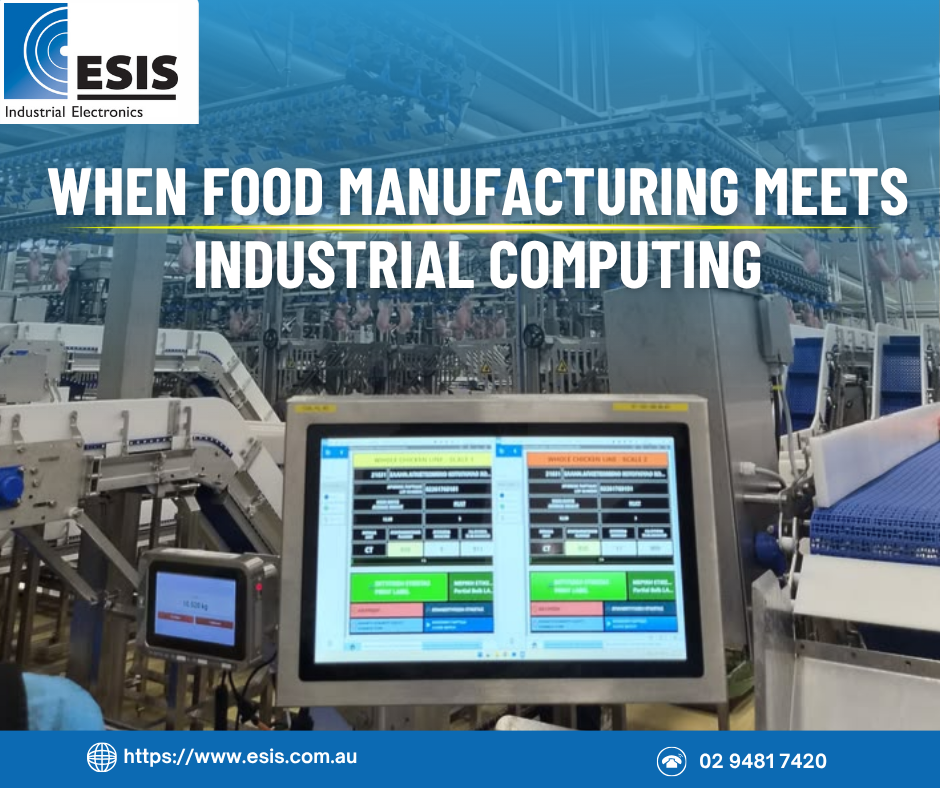
Food and beverage plants are demanding environments for computing hardware. Moisture, chemical cleaning, temperature extremes and hygiene requirements all place constraints on specification that go beyond a simple IP rating. Engineers and integrators who understand these constraints specify correctly from the outset. Those who don’t tend to discover the gaps after commissioning!
Here’s what to consider in order to avoid some common pitfalls.
What IP ratings actually mean
An IP65 rating on a panel PC’s front bezel means it’s sealed against dust ingress and low-pressure water jets. This is adequate for many food manufacturing environments, but the rating only applies to the front face. The rear of the unit is typically a lower rating, sometimes IP20 or less, meaning it has no meaningful protection against moisture or dust.
This distinction matters. An IP65-rated panel PC mounted correctly into a sealed enclosure cut-out, with the front bezel properly seated against the enclosure front panel, provides genuine protection. The sealed front faces the production environment while the unprotected rear sits inside the enclosure, away from moisture and contamination.
But if the panel PC is not installed into an enclosure, or the enclosure cut-out is poorly sealed, or cable entries are not properly grommeted, the IP65 front rating is meaningless. Water, cleaning chemicals and dust will find their way to the unprotected components.
For applications where the PC or monitor cannot be installed into an enclosure, fully sealed IP66 units are available that provide protection on all sides. These are more expensive and the product range is more limited, but in genuine washdown areas or where enclosure mounting is not practical, they are the correct specification.
IP ratings don’t address condensation
IP ratings cover resistance to external water and dust. They do not address condensation forming inside the equipment.
Cool rooms and cold stores can be particularly problematic. When a door opens, warm humid air rushes in and meets the cold surfaces inside. Moisture condenses on anything cooler than the dew point, including the internal electronics of any computing equipment in the space. In a busy production facility, cool room doors may open dozens of times per shift.
The risk is highest when equipment is installed near doorways or in transitional areas between temperature zones. Condensation on circuit boards and connectors can cause immediate short circuits or, more commonly, slow corrosion that degrades connections over months until the system becomes unreliable.
Equipment installed in cool rooms needs to be rated for the operating temperature, correctly sealed, and positioned to minimise exposure to the worst condensation events. In some cases, a small amount of heat generated by the PC itself helps keep internal surfaces above the dew point, but this should not be relied upon as the sole protection strategy.
Stainless steel isn’t really optional
Standard industrial PCs and panel PCs are typically constructed from powder-coated steel or aluminium. These materials are adequate for general industrial use, but in food manufacturing environments, they can present problems.
Powder coatings can be damaged by repeated exposure to chemical cleaning agents, caustic washdown solutions, and the mechanical abrasion of daily cleaning. Once the coating is compromised, the underlying steel corrodes. Aluminium is more resistant to corrosion but can react with certain alkaline cleaning chemicals commonly used in food plants.
Stainless steel is the expected material for equipment surfaces in food production areas. It resists the cleaning chemicals used in daily washdown, doesn’t corrode under normal conditions, and meets the hygiene expectations of food safety auditors and site managers. For panel PCs and monitors installed on the production floor, stainless steel bezels and enclosures are effectively a baseline requirement rather than a premium option.
Most industrial panel PC manufacturers offer stainless steel bezel options, and purpose-built stainless steel enclosures are widely available for housing PCs and monitors where the standard unit does not include a stainless front panel. The enclosure material needs to match the environment. A well-specified PC installed in a mild steel enclosure with a deteriorating powder coat finish will not pass a hygiene audit regardless of what the PC itself is made from.
Temperature at both ends of the scale
Food manufacturing spans a wider temperature range than most industrial environments. A PC controlling a freezer environment may operate at minus 20 degrees Celsius or lower. A PC inside an electrical enclosure in an uncooled warehouse in summer may see sustained temperatures above 50 degrees.
Standard industrial-grade components are typically rated to 0 degrees Celsius at the low end. For freezer environments, wide-temperature-rated components are essential, with ratings as low as minus 40 degrees. This applies not just to the PC itself but to all internal components including RAM and SSDs. A PC rated to minus 20 degrees with standard RAM rated to 0 degrees will not perform reliably in a freezer.
At the other end, fanless industrial PCs installed inside sealed enclosures generate heat that has nowhere to go. The temperature inside the enclosure can be 15 to 20 degrees above the ambient outside it. If that enclosure is in an uncooled warehouse where ambient temperatures already reach 40 degrees in summer, the PC is operating at 55 to 60 degrees. Wide-temperature-rated RAM and SSDs become important here as well, even though the application does not seem extreme at first glance.
Touchscreens: wet hands, gloves and droplets
In food manufacturing environments, operators frequently have wet hands, wear gloves, or work in areas where water is present on surfaces. Touchscreen technology choice has a direct impact on usability in these conditions.
Resistive touchscreens respond to physical pressure rather than electrical conductivity. They work reliably with wet hands, gloved hands or a stylus. Water droplets on the screen surface don’t cause false touches. This makes them well suited to food manufacturing environments where moisture is constantly present. Their main limitation is lower optical clarity and reduced durability compared to capacitive screens, and they don’t tend to perform well in direct sunlight, though this is rarely a concern inside a food plant.
Projected capacitive (PCap) touchscreens offer better optical clarity, multi-touch support and a more responsive feel. However, standard PCap screens can register false touches from water droplets on the surface, which is a significant problem in wet environments. Some PCap controllers can be configured to a lower sensitivity setting that reduces false triggering from water, but this needs to be verified for the specific model and tested in the actual operating conditions. Not all PCap screens offer this adjustment.
For most food manufacturing applications where moisture is present, resistive touch remains the more reliable choice unless the specific PCap model has been proven to handle wet conditions in that environment.
The control room is not immune
Not every PC in a food manufacturing plant sits on the production floor. SCADA servers, batch management systems and monitoring terminals often sit in air-conditioned control rooms, well away from the moisture and temperature extremes of the plant.
It can be tempting to specify standard commercial PCs for these locations, since the environment appears benign. We see this regularly, and the reasoning is understandable: why pay for industrial grade when the PC is in an office environment?
The answer is that the environment is only one factor. The other is what the PC does. A SCADA server controlling a production line is mission-critical regardless of where it’s physically located. If it fails, the plant stops. An industrial-grade PC in a control room provides longer component life, longer platform availability for sourcing replacements and spares, and the kind of reliability that justifies its cost many times over when compared to the cost of unplanned downtime.
We have supplied industrial-grade fanless box PCs and rack mount systems for control room applications in food manufacturing for exactly this reason. The environmental protection is not the primary driver. The reliability and long-term availability are.
Getting the specification right
In food manufacturing environments, careful specification pays off, and assumptions can kill your project. The following areas must be carefully evaluated for every PC going into such environments:
- Use stainless steel for production areas. Standard powder-coated steel and aluminium won’t survive repeated exposure to washdown chemicals. Stainless steel bezels and enclosures are the baseline for any equipment installed on the production floor.
- Match the IP rating to the actual installation. An IP65 front panel is adequate for most production areas if the PC is correctly mounted into a sealed enclosure. For washdown areas or installations without enclosures, specify IP66 on all surfaces.
- Account for condensation. In cool rooms and cold stores, especially near doorways and transition zones, condensation is a greater risk than direct water exposure. Equipment selection and positioning both need to address this.
- Specify temperature ratings for all components. The PC, RAM, and SSD all need to be rated for the actual operating temperature, including the temperature inside the enclosure, not just the ambient temperature outside it.
- Choose the right touchscreen technology. For wet environments, verify that the touchscreen works reliably with water on the surface, wet hands, and gloved hands. Don’t assume that all touchscreens behave the same way.
- Use industrial-grade hardware for critical systems. Even in an air-conditioned control room, the PC running your SCADA or batch management system deserves hardware that matches the criticality of its role.
- Understand what you are replacing. Before specifying a replacement for a failed unit, take the time to understand the full scope of the original installation. A purpose-built machine-integrated panel PC is not the same as a standard panel-mount unit, and discovering that after ordering costs time and money.
How ESIS can help
We have supplied industrial PCs, panel PCs, and monitors into food and beverage manufacturing environments for many years, including long-term supply relationships with major Australian food producers. We understand the specific requirements of these environments and can help you specify hardware that matches the actual conditions on site.
Whether you are specifying panel PCs for a new production line, replacing legacy hardware on existing machinery or reviewing the reliability of your current SCADA infrastructure, we can help you get the specification right from the start.
Contact us to discuss your requirements.


