
Industry 4.0 and its newer iteration, Industry 5.0, are shaking up the manufacturing sector, using data to digitally transform almost every industrial production process. But when data drives decisions, every authorised employee in a manufacturing facility needs access to relevant and contextual information – in the right place, at the right time, on the right device.
Rugged devices are the ideal vehicle for data-driven digital transformation in manufacturing, standing up to harsh operating environments and allowing workers to access and act on sensor-gathered data from industrial assets in real-time.

How manufacturing is changing
For decades, the manufacturing industry has struggled with a range of operational challenges, from crippling downtime of manufacturing equipment, to sub-optimal workflows and shaky manual inspection processes. When issues inevitably arise, they cost time, money and resources to resolve, often at the expense of the bottom line.
With the advent of Industry 4.0 and 5.0, manufacturers can now use connected sensors to drive predictive maintenance models that decrease asset downtime and reduce costs. Robotics and automation form a core pillar of Industry 5.0, integrating collaborative and industrial robots. Additive manufacturing, also known as 3D printing, is another key technology, enabling the production of complex parts quickly and precisely, and allowing on-demand production of spare parts in industries such as aerospace, automotive and healthcare.
Technology is reshaping manufacturing at an ever-increasing pace, and we’re only just scratching the surface of what’s possible. For example, recent advances in artificial intelligence and machine learning are already being used to fine-tune operations to a level far beyond what was previously thought possible, from vendors to the manufacturing floor, and even end-of-life.
How rugged devices support the transformation
Rugged laptops and tablets support the transformation of the manufacturing industry in a variety of ways.
Enhanced durability and reliability
With high ingress protection (IP) ratings, MIL-STD certifications, and ability to withstand accidental knocks, bumps and liquid spillages, rugged devices can withstand the harsh conditions that are routine in the sector. This has quickly made them an essential part of the manufacturing tech stack.
Improved safety, efficiency, and predictive maintenance
Rugged devices can help reduce unplanned downtime and accidents resulting from equipment failure by giving workers real-time access to data from predictive analytic models. Workers can also use rugged devices to read and update maintenance records and check on crucial steps in production workflows.
Effective workforce training
Rugged devices that facilitate advanced technologies such as mixed reality and augmented reality enable employees to complete training more easily, combining real-world situations with digital training modules. These technologies also enable less experienced workers to take on more complex tasks and troubleshoot problems by remotely consulting with technical experts in real-time as needed.
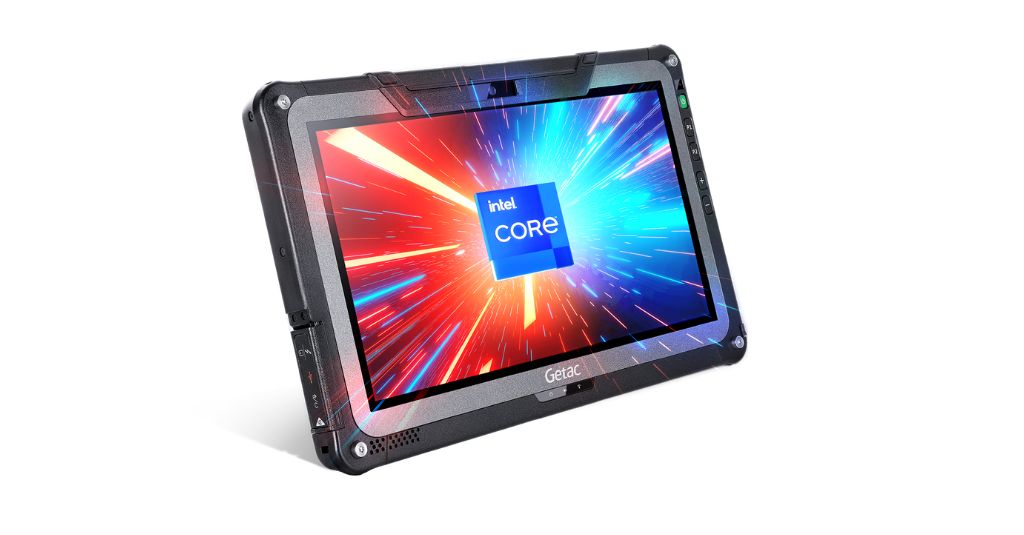
Fully rugged tablets like the Getac F110 feature 13th generation Intel® Core™ CPU, with Intel® UHD Graphics run the latest Edge AI and AR/VR applications smoothly, delivering power and rugged performance in challenging environments.
Enabling computer numerical control
One significant advantage of rugged devices is they enable computer numerical control, which is essential for achieving highly automated and precise manufacturing processes. This technology allows for the remote control of machine tools such as 3D printers and laser cutting machines, enhancing efficiency and accuracy in production.
Supporting sustainability
Tied in with efficiency gains, rugged devices help the manufacturing sector optimise processes and shave off excess waste, a key pillar of sustainability initiatives. Knowing when to replace components thanks to predictive analytics helps companies keep assets running efficiently. Digital twins, which help sustainability initiatives, can also deliver real-time optimisation suggestions to workers through rugged devices on the manufacturing floor.
Lower total cost of ownership (TCO)
While rugged devices can have a higher initial capital investment than consumer-grade equivalents, a growing number of organisations are recognising that overall total cost of ownership (TCO) is significantly lower over the product lifecycle. In fact, 35% of respondents in a Getac-sponsored IDC survey of 990 IT decision-makers expect a TCO reduction of over 20% once rugged devices are implemented. Those who have already put rugged devices to work noted significant reductions in equipment failure and replacement costs, as well as improvements in worker productivity and remote access to data systems.
The impressive range of advantages that rugged devices offer in manufacturing make consideration of TCO a must when deciding whether to invest in them. Data is already key to manufacturing efficiency and will only become more important over time. The long-term savings from being able to harness automation and advanced technologies for cutting costs and improving business operations typically far outweigh the costs of initial investment.
Considerations for selection of rugged devices
As with the addition of any new hardware in a tech stack, companies need to conduct due diligence before integrating rugged devices into their everyday processes. This should be viewed in the context of the Industrial Internet of Things (IoT), where data freely flows between employees, machines, equipment and production lines. Key factors to consider include:
System compatibility
Given that real-time data is the key to Industry 5.0, it needs to flow seamlessly between the various software systems that the company uses. IDC’s survey found that rugged devices in industrial manufacturing will most likely be integrated with manufacturing execution systems (MES), supply chain management systems, and warehouse management systems (WMS). To do this effectively, devices need to have the necessary standards for integration and interoperability so they can plug and play into existing tech stacks.
Scalability and future functionality
The rugged devices that companies pick today need to account for future use and integration of technologies coming down the line. Maintenance and support systems for the stack will likely change depending on needs as well.
Integration into existing workflows
The key value proposition of rugged devices is that they improve business operations through data driven decisions. So, companies need to evaluate existing workflows and ensure rugged devices can be used to effectively eliminate bottlenecks and improve processes before making any large investments in them.
Employee buy-in
Any new asset introduced brings change, which can be difficult for employees to adapt to. But the right training can make adoption easier. Team members are often much quicker to embrace new technology when they realise that it can make their day-to-day duties both quicker and easier to perform.
Environmental conditions
While rugged devices are purpose built for challenging work environments, it is still prudent to evaluate the conditions under which they will operate and ensure they have the necessary certifications before investing in them. Many rugged devices also offer optional protection against environmental hazards like salt fog or are available in intrinsically safe variants for operation in potentially explosive environments.
A data-driven future for industrial manufacturing
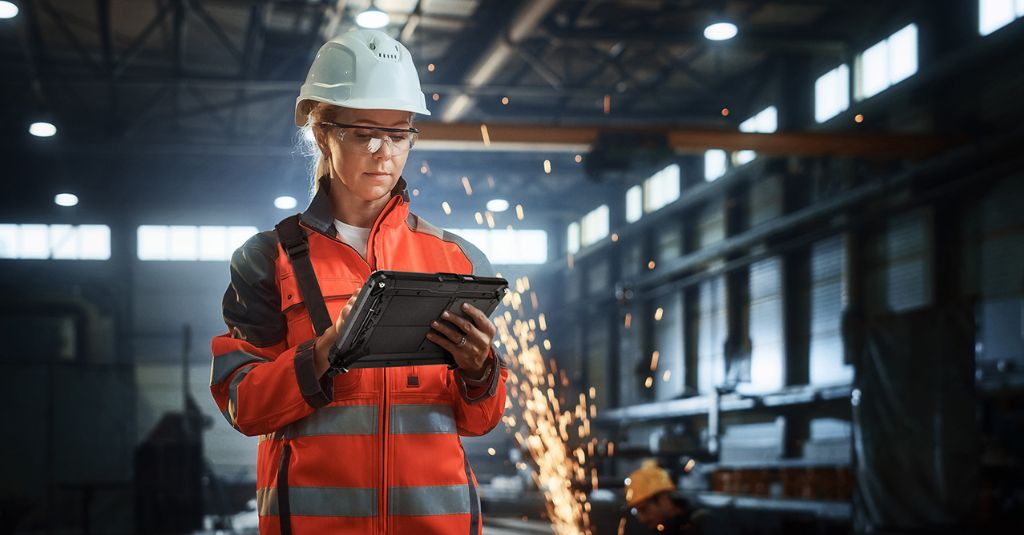
Several OEMs in the industrial manufacturing sector are already realising the operational efficiencies that rugged devices deliver.
Aerospace titan Boeing uses rugged devices for quality control, inventory management and a host of other tasks. Aircraft manufacturing environments are extremely dusty, and devices must withstand regular exposure to heat and vibration as well.
A similar scenario plays out at General Motors, which uses rugged devices to troubleshoot disruptions in production and assembly. Employees access in-house software systems to ensure smooth workflows, get ahead of supply chain challenges and even schedule time off.
As these examples prove, rugged devices are quickly becoming essential tools for accessing and sharing relevant information in challenging manufacturing environments. They offer a platform for data insights that are the result of a growing range of innovative technologies, from artificial intelligence to digital twins and more. Being able to harness data in real-time and use it to improve processes is vital to staying ahead of competitors, both now and in the future.
Rugged devices and solutions help manufacturers harness the full benefits of digital transformation. Partnering with the right technology vendor enables organisations across the sector to navigate the constantly changing complexities of modern manufacturing while also meeting sustainability targets.
At ESIS Industrial Electronics, we offer a range of solutions to meet your industrial user interface needs. Whether you require a rugged, high-quality display, a powerful integrated computing platform or a programmable interface for direct PLC integration, we have the right equipment to ensure your operations run smoothly and efficiently.
For more information, visit www.esis.com.au or contact our team to discuss your specific requirements.
Article courtesy of Getac.


