
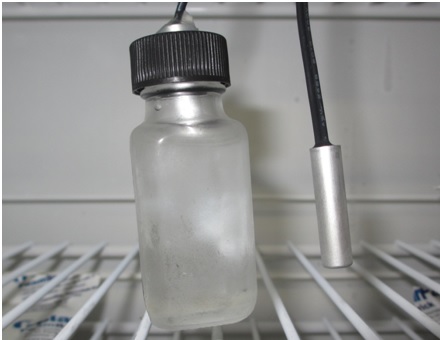
What is thermal damping of temperature probes? Thermal damping is mainly used where you are monitoring temperatures of sensitive goods in fridges, using temperature data loggers. Instead of placing the temperature probe directly in the fridge, the temperature probe is placed inside a “buffer” object, such as a small bottle of liquid or a block of metal, which is then placed in the fridge alongside the goods. This attempts to mimic the thermal response of the goods that are stored in the fridge.
Consider the case of vaccine bottles stored in a fridge. If the fridge door is opened briefly, with a bare temperature sensor it may register an alarm as the warm air enters the fridge. However, the actual goods stored in the fridge will not get spoiled from brief door openings because they take time to warm up, and the fridge’s thermostat will kick in and cool them down again. So if you place the temperature probe in a damping device, the temperature sensor will not register an alarm when the door is opened briefly, as it will take time to warm up.
So, should I use thermal damping devices for temperature sensors? Mostly it depends on your application, but for mapping studies we usually advise against damping the measurements. This is because almost every controlled environment that needs to be qualified provides a stable environment for the stored item by bathing it in temperature-controlled air. The temperature of the stored item is dependent on the temperature of the air. The air temperature will fluctuate based on normal control cycles and the stored product temperature will fluctuate accordingly. The product temperature will fluctuate less because it will always have a higher specific heat than the air. Therefore the product will experience temperature fluctuations that are damped relative to the air temperatures.
But before we give our comments, there is a paper on research into thermal buffering methods in a paper published by NCSLI. They tested 20% concentrations in several aqueous media in different vial sizes, but found no significant differences.
Instead, their tests determined that the location of the probe inside the chambers had a larger impact. Meaning, whatever buffer you use for whatever probes you use, probe placement within a monitored space is crucial. Placing the buffered probe in the geometrical center of the monitored space will be usually be the most representative of the temperature of the space.
Temperature Damping in Application
Products generally have a higher thermal mass than air. The actual air temperature represents the worst-case scenario. Product temperature (which we can think of as a damped signal) will always show less fluctuation than air. In mapping/validation applications we always want to address the worst-case scenario, so measuring the undamped air temperature is the right choice; both easy to defend, and easier to do.
But this raises the question as to whether there are there any cases where we would dampen a probe for a mapping study. This comes up as a question when the environments fail to perform appropriately when we measure air temperature. When this happens it is often a symptom of 1) failing equipment, or 2) equipment that is not suitable to the task. In these cases adopting a practice of mapping a damped air signal is just hiding the fundamental problems that either the equipment is failing or the equipment is not suitable.
However, when a validation expert says a damped air temperature just hides bad equipment, this rarely means that your customer will magically obtain a budget to buy new equipment. It’s more likely that the customer will move forward with their plans to map with faulty equipment, and expect you (the validation expert) to find an appropriate solution. This can happen when validation is put at the end of the project, rather than the beginning.
Whatever the reason, folks running validation studies are left with a challenge. Our recommendation is to map bare sensors in air, undamped signals, to see if the environment can meet the acceptance criteria when mapping air temperature as the worst-case scenario. Do this even if you expect that it will fail. Once it fails, then you have a rationale to support using a damped signal, and you will know how much damping might be required based on your original study data.
Let’s say you have mapped an area and the data did not met acceptance criteria. Now you need to map again. Examine what will be stored in the environment. You don’t want your artificial damping of the sensors to exceed the natural damping that the smallest items stored in the environment will experience. For instance, if the smallest item stored in the environment is 50ml vials of liquid product, then we would want to use a significantly smaller volume of placebo product (say 20ml vials of glycol) in which to place our sensors.
You get the idea… the mapping study will be compromised (read “meaningless”) if the product stored is more sensitive to temperature than the sensors we are using to map the environment. And, when we are done with our mapping, procedural controls will be needed for that environment to make sure that no products smaller than 50ml are ever stored in the area.
So you can damp you air temperature signal. However, in our experience this often just covers up failing or inappropriate equipment. It may be subject to questions under audit. And it will require ongoing procedural controls for the mapped environment.
Now you may ask: Does this logic apply to constant monitoring after mapping has been completed and units are in use?
Yes, and no. Monitoring applications are a different story. Mapping studies show that a process performs reliably using challenge scenarios such as the worst-case examples. Monitoring is quality control to ensure the process is running correctly. But wait! There are some variables to consider…
With monitoring you are ideally selecting your sensor positions, and often alarm limits, on information derived from your study. For this process to have some continuity to it, we would expect that the monitoring process would follow our mapping process. To say it another way – if we started damping our signal to monitor, would we have a reasonable expectation that our data would be comparable? We would be monitoring the process in a way that wasn’t used in the mapping study and then expecting to be able to make comparisons with the data.
But this is often what people do.
They just place a monitoring probe in the chamber, damp the signal with glycol or some solution, and don’t give it another thought. What will your auditor say? You have validated your chamber by mapping (well done!), so you are monitoring with a validated monitoring system, and even if the damped monitoring data isn’t comparable to your mapping, or proven to be equivalent to your typical load, at least it will capture catastrophic failures in your chamber – power loss, compressor failure, door left open, etc.
Obviously we support the practice of monitoring in air temperature. The disadvantages of monitoring air temperature is that the temperatures change faster and respond more easily to environmental perturbations such as leaving the chamber door open or adding product of a different temperature.
However, these perturbations are things that represent a chamber that is not be properly managed.
With well-trained personnel, doors aren’t left or held open. With proper handling procedures, new stock is conditioned at the appropriate temperatures before it is placed in our chamber. However, with a damped monitoring signal – these problems (which are usually indicators of poor processes, ineffective training, and failing equipment) go away.
Problems shouldn’t be hidden and the undamped signal of air temperature in your chamber can tell you about more than the performance of your refrigerator, it can tell you about the performance of your department. Furthermore, with an advanced monitoring system that is fit for its purpose, you can use alarm delays to achieve many of the same effects as a damped signal without losing the data sensitivity. This is a better use of technology to get honest data and set up smart monitoring.
So what are the major disadvantages and advantages of a damped signal?
On the positive side: damped signals offer simplicity in operation. You can install your sensors and forget. On the negative side: you risk a mess from spilled damping fluid in high traffic areas. And you risk a mess in the logic of your monitoring process because the data is not truly representative of what the product is experiencing. You will lose the ability to evaluate deviations unless you know that your damped signal is always more sensitive than your product. One possible solution would be to do a study to ensure that your damped monitoring signal is approximating your product.
We have seen some industries successfully damp monitoring signals, such as eye/cornea banks, where guidance specifies that the sensor be placed in 20ml of Optisol, as this is the recommended way to store a cornea. However, eye banks deal only in corneas, and all corneas are conservatively very similar.
In the field we see most firms damping the monitoring signal and the practice is not going away. So long as we continue to perform our mapping studies, place continuous monitoring in place that ensures no gaps in the data, and have alarming as a component of your monitoring system. Always, it’s important to know your environment (mapping) and understand the temperatures required by your products and processes.
(Based on an article by Vaisala)


