
The pharmaceutical industry has been expanding rapidly, resulting in increased regulatory controls. To deal with this challenge, companies are implementing state-of-the-art automated storage and retrieval systems. However, as pharmaceuticals are extremely sensitive to temperature, it is not enough just to rely on the primary system to take care of temperature monitoring. To guarantee the storage conditions are 100% compliant, a secondary temperature monitoring system can be used, with more sensor locations along with traceability and redunancy.
Application: Wireless temperature monitoring of stored pharmaceuticals
Organization: Leading global pharmaceutical company
About the Customer:
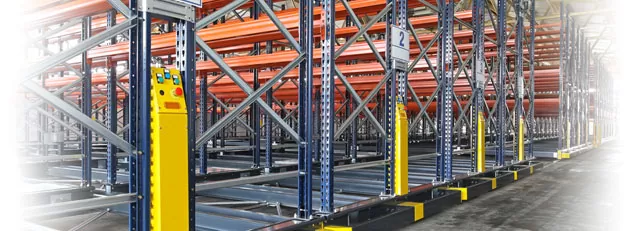
Among the top 15 pharmaceutical companies in the world, this organization specializes in the development, production and marketing of branded pharmaceuticals and active ingredients. Recently they installed at the main production site one of the top ten largest automated storage and retrieval systems in the world. The system has a volume of over 226,800 square meters and a capacity of 38,069 storage locations. PLC and control technology is used to manage the facility’s logistical system, automatically tracking and retrieving each inventoried item.
Key Customer Challenges:
Strict Regulations
- All temperature sensors must maintain
accuracy of ± 0.5˚ C - Materials must be stored between 15 and 25˚ C to avoid spoilage
- Audits and validation directives demand comprehensive reports without data loss
Highly perishable goods
- Extremely sensitive materials can be ruined if exposed to high temperatures
Implementation Obstacles
- The vast scale and use of metallic material throughout the warehouse requires a very robust data logging system. Each storage aisle alone measures 40 meters in height and 150 m in length, providing a very condensed clean space for data transmission.
- Measuring points span several floors, each floor with a complex system of electrical power grids and air conditioning units, using high voltage currents.
DataNet Implementation:
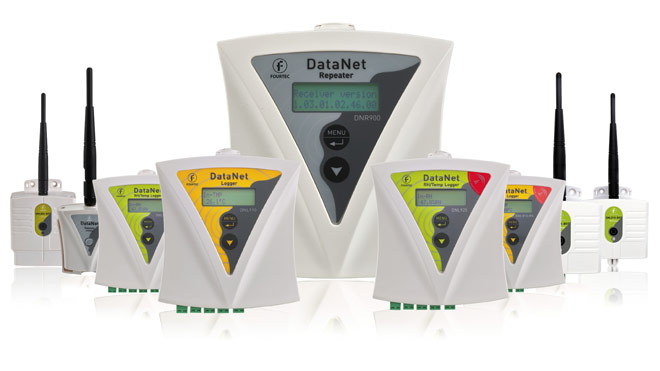
Functioning as a backup and increasing the density of the facility’s existing built-in sensors, the DataNet wireless data logging system ensures limitless monitoring points throughout every warehouse zone. Flexible onsite deployment provides secure, real-time data backup.
System Configuration – 85 Mini DataNet (DNL808) units with external NTC temperature sensors were installed and configured to the 10-minute sampling rate and 20-minute transmission rate. Low and high alarm levels of 15 ˚C and 25 ˚C respectively were set. To accommodate the warehouse dimensions and ensure robustness of the DataNet network, 9 Mini Repeaters (DNR800) were also installed, for an extended transmission range.
Operational Procedure – A bi-weekly procedure driven by regulatory-compliance was implemented. The accuracy of all temperature probes is verified in a calibration bath before a one-week deployment throughout the warehouse. Specific deployment of each logger may differ depending on the season, after taking into account heat, humidity and air flow changes. Recorded data is then exported to Microsoft Excel ™ and a PDF report generated with alarm notifications defined. All units are retested to ensure their sensor accuracy was maintained. This process produces reports with a 3-year validation, satisfying the Ministry of Health and FDA regulations, as well as customer and internal audits.
Measurable Results:
- Zero data loss – The units’ internal memory stores data, no matter what transmission disruptions occur, allowing full data retrieval and transfer at any time.
- Standalone – The Mini DataNet’s long battery life allows the system to be deployed anywhere, without requiring electrical points or extension cables.
- Scalable and reliable monitoring – ZigBee technology overcomes transmission obstacles, automatically finding the most cost-effective, efficient and secured data path to the PC. As units are constantly relocated, or Repeaters introduced to increase the network range, the intelligent system remains flexible and trustworthy.
- User-friendly software – In this complicated and large-scale environment, the DataNet software provides a clear visual map of the data network path, deployed units, alarms indications, and data strength and flow throughout the facility.
- Multi-setup – Rather than individually configuring each logger, 85 Mini DataNet units were configured with a single click, saving valuable installation time.
- Meeting regulatory requirements – Using the data export to Excel ™ feature proves data integrity and the intuitive Reports module provides transparent data records for achieving regulatory compliance.
ESIS has been a leading supplier in the Australian industrial electronic equipment market, since 1971. Browse through our extensive range of products and services, designed exclusively to fulfil your needs.
Contact us today to learn more about wireless data logging, or feel free to check out the options on the ESIS website.
Article courtesy of Fourtec.


