
Outdoor air pollution has been a hot topic in public for quite a while due to the rising number of health symptoms and even deaths the emissions have caused. The thing is that, while fighting the outdoor pollution, we forgot that people spend close to 90% of their time indoors, not outdoors. Indoor air pollution seems to be a commonly overlooked (and now rising) topic in the field of air quality studies.
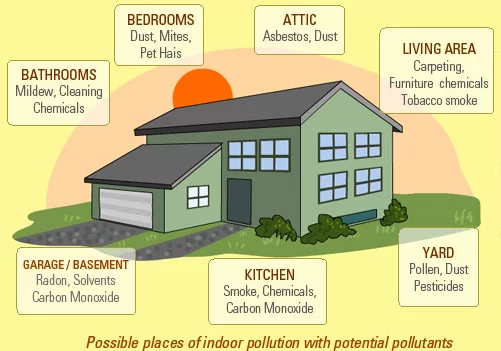
Indoor air quality is quite tightly linked to outdoor air quality. Due to inefficient building sealing, filtration and ventilation, many outdoor pollutants come indoors almost in the concentrations they appear outside. Indoor carbon monoxide, nitrous oxide, some volatile organic compounds (VOCS) and many more pollutants come from outdoor sources and cause us health risks indoors as well as outdoors.
“The buildings in western countries at least are well sealed, so the outdoor pollution is well kept away from indoors”. This might have crossed your mind, but not all indoor pollution comes from outdoor sources. If the building really is well sealed and the ventilation tightly controlled, the concentrations of hazardous substances in the air still start to build up quite quickly indoors. But where do these substances come from? We have our neighborhood pals Radon, Mould and Other Particular Matter, but what’s even more overlooked, in this time of energy efficiency savings by ventilation control, is Carbon Dioxide.
Usually indoors we, the people, are the main cause of pollutants – and the pollutant we produce the most is carbon dioxide via our respiration. Although CO2 gas in nature occurs in concentrations around 400 ppm in the fresh outdoor air we breathe, it causes some interesting effects in higher concentrations on people even in normal everyday environments.
The researchers have found some intresting results. Remember when you sat in history class at school and felt like the air was running out? You almost fell asleep and after the class you couldn’t recall anything the teacher had taught you. The researchers from Harvard’s Center for Health and the Global Environment studied how green buildings positively affect health and cognitive function. They saw people’s cognitive function increase by 101% just by doubling ventilation from the recommended levels, decreasing VOCs from regular concentrations to outdoor concentrations and decreasing CO2 concentrations from 950 ppm to 500 ppm. The wildest performance increases were in people’s crisis response (131% increase), strategic solutions (288% increase) and information usage (299% increase). And as we’re talking about comparing against regular office conditions, think how the worst office conditions would affect people. It’s crazy that in some schools there have been reported CO2 levels of even 6000 ppm momentarily. No wonder I remember almost nothing from the history classes in school (it’s probably not all due to the sleep deprivation from staying up late!). Even crazier is that the regulatory limit for CO2 in indoor air is 5000 ppm average during an 8 hour time.
This may be over-exaggerating, but the topic is still very interesting. It is definitely important to measure indoor air quality accurately and provide systems to avoid excessive CO2 indoors. A simple and effective system often used in buildings is demand controlled ventilation. In this system, CO2 sensors designed for demand controlled ventilation, would be installed in suitable locations in rooms frequently occupied by lots of people. These sensors would have a set point and a relay output, which connects to ventilation fans (perhaps near the roof). Thus when the CO2 level goes above the set point, the ventilation fans would automatically switch on, to bring the CO2 level back down again.
And what about the bigger picture? Just food for thought, if this is how carbon dioxide indeed affects us, what will the rising levels of carbon dioxide in the environment do to our performance and well-being as a society, in future? The concentration of CO2 in nature has risen from around 280 ppm in the 1950’s up to 406ppm today and it just continues to rise at an accelerating pace. And how about NASA’s forecast of 1500 ppm CO2 concentration in a few centuries from now? It’s not a pleasant thought.
Concerned about the CO2 level in your building? Check it with a CO2 monitor, or ask us about installing demand controlled ventilation using a Vaisala CO2 sensor. Please contact us to discuss your needs in more detail.
(Article courtesy of Vaisala)


