
Capacitive touch screens and resistive touch screens are the two types of touch screens that are most widely used with Industrial PCs. However these touch screen types do not always work well when placed in extreme temperature environments. Read on to find out which kind of industrial touch screen is best suited for your application.
Capacitive touch screens make use of conductive layers to produce voltages when a conductive object like a finger comes close to the screen. Thereby, they generate relative currents due to the moisture present in the body.
In a low-temperature environment, the skin of the user remains less moist due to the lack of water vapour content and thus has poor conductivity. Such conditions affect the performance of the capacitive touch screens’ sensor, and thus, the Industrial PCs can fail to detect the touch points when used by people in a very cold environment.
Hence the temperature range in which capacitive touch screens perform optimally is -5°C to 60°C. This means the performance of capacitive touch screens becomes challenging in outdoor areas subject to below zero temperatures, or when used in freezer rooms.
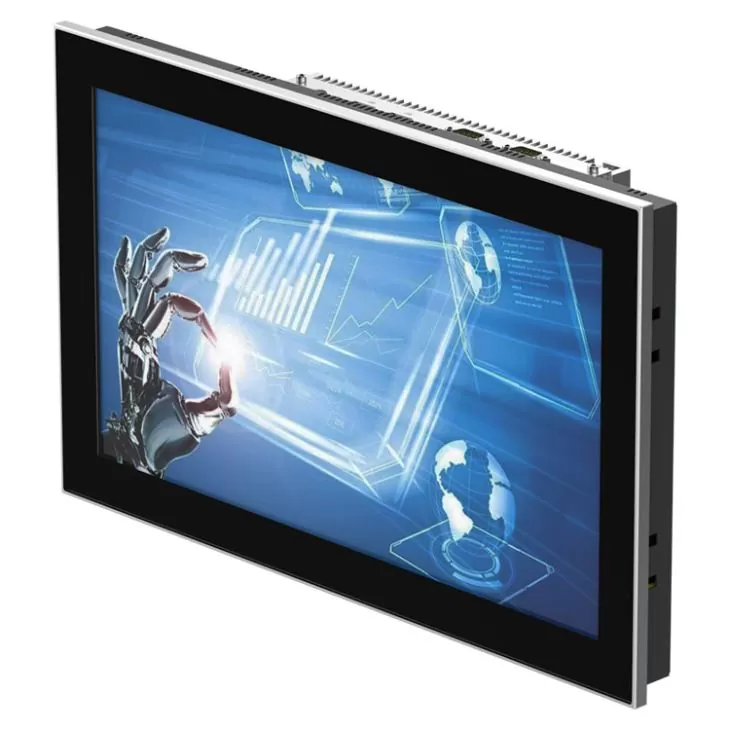
Photo courtesy of TAICENN
On the other hand, unlike capacitive technology, resistive touch screens get less affected by temperature. These touchscreens work using layers of special flexible conductive plastics, which touch one another when pressed. The current technology used in these 5-wire touchscreens are more advanced than early resistive screens, and the materials are tough and long-lasting.
Hence industrial panel PCs with resistive touchscreens can perform at much lower temperatures, operating between -20°C and 65°C.
Apart from the above-mentioned touchscreens, two other commonly used touchscreens in industrial Panel PCs are surface acoustic touch, and infrared touch screens.
The infrared touch screen performs excellently even in the presence of static electricity. However, these touchscreens only have a single sensor that easily gets damaged and cannot withstand environments with high pollution and complicated maintenance. In addition, under low temperatures, the static electricity produced by these infrared touchscreens attract dust and affects the performance of industrial LCD monitors. Thus, infra-red touchscreens are mainly suitable for aerospace.

Photo courtesy of TAICENN
When it comes to surface acoustic wave touch screens, they have light transmittance that can reach up to 92%, giving excellent screen brightness. These touchscreens perform accurately irrespective of humidity and temperature and need to be adjusted only at the time of installation.
However, the surface acoustic wave screens can have high maintenance costs in dirty or dusty environments, needing frequent cleaning and servicing. If the surface of the touch panel of these PCs come in contact with dust or contaminates, the micro grooves in the screen will get blocked, which prevents the acoustic waves from transmitting properly, hence the touch controller will stop functioning. Industries with such panel PCs must pay attention the environmental hygiene and keep cleaning the screen regularly.
ESIS specializes in Industrial LCD Monitors and Industrial PC’s, and is the leading supplier of industrial electronic equipment in the Australian market since 1971. Choose from our wide range of products to best suit your requirements.


