
A wide variety of tools are used for different art restoration processes, ranging from high tech equipment to medical scalpels, carpentry equipment, writing brushes, rubber erasers, and even chemicals. In addition, humidity measurement instruments are needed as variations in humidity can greatly affect a piece of art and potentially damage it beyond repair.
For paintings to last through posterity,one must pay careful attention to not only the restoration of the works of art, but to the environment in which they are preserved. Just
restoring it isn’t enough; extra measures need to be taken to ensure that the art is maintained in good condition.
“I propose preservation environments to ensure that the work of art remains at the temperature most appropriate for preserving it,” says Ms. Kikuko Iwai, one of only a small number of painting restorers in Japan.
A pioneer in her field, she has worked as a freelancer for around thirty years with art museums, private collectors, galleries, and artists in Japan and all over the world.
Ms. Iwai has worked on paintings from such greats as Rembrandt, Van Gogh,Picasso, Monet, and Matisse. She first dealt with painting restoration work in 1974. She was introduced to the field by her father, who had a construction job at an art museum. At the time, she was still a college student who had her sights set on being a painter, but painting restoration work piqued her interest to the point that it became a lifelong occupation. She studied restoration techniques in Japan, and spent time studying in London art museums. While she certainly acquired techniques in London, the ideas that she picked up turned out to be a bigger asset even.
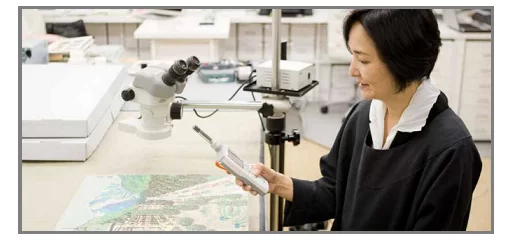
A wide variety of tools are used for different restoration processes,ranging from high tech equipment such as magnifying glasses, microscopes, hygrometers, and illuminometers to medical scalpels, carpentry equipment, writing brushes, rubber erasers, and even chemicals.
Retouches of oil paintings do not use oil-based paints. They use materials such as adhesives and peelers that have been extensively tested for safety. But just because something is safe doesn’t mean it won’t damage the texture of the work of art. Making the right decision is vitally important. Among her numerous tools, Ms. Iwai has used the Vaisala HUMICAP® Hand Held Humidity and Temperature Meter in the past twenty years.
It is very important to check the humidity levels in display rooms. On occasions such as when a work of art is borrowed from overseas, there are very minutely detailed contract conditions, such as specifications to keep the work in an environment with a humidity level of 50% +/-5 and a temperature of 20°C +/-2.
“I travel to these places all the time to perform checks. I set a Vaisala transmitter’s measured value as the standard value, and when it is off even a little bit from the specified acceptance range, I give strict advice to curators and those in charge of art museum facilities to fit it all back within the standard.”
Humidity Adjustments Critical
Recently, Ms. Iwai worked on a Picasso painting from over 80 years ago. The colors were peeling visibly, and the canvas had sagged to the point that it was touching the wooden frame.Preserving the piece required a process in which the canvas would be removed from the frame and replaced on a new panel designed for the purpose of preservation. The process involves applying steam from behind, measuring the humidity level, and gauging just the right timing to slowly stretch the canvas out with the utmost of caution. Needless to say, this is extremely intense and delicate work where one small mistake can damage a world-famous piece of art for good. What helps here are humidity measurements.
“Slight alterations to humidity levels will cause a canvas to greatly change. Humidity adjustments are the most important thing for paintings,” Ms.Iwai says. “Elevated humidity will cause a canvas to soften up. By stretching it to the point of surface evenness in this state, then drying it, we can eliminate sagging without any loss of integrity in the painting. A difference of only 1-2 percent in the humidity level can be critical for a work of art, which means that a measurement device must be extremely accurate. Otherwise, it’s unusable.”
Ms. Iwai places strong emphasis on preservation alongside restoration of works of art. In addition to restoration work, she has worked a lot as a designated courier, i.e. a person in charge of the safekeeping of the works of art that are borrowed from Japanese art museums to overseas exhibitions.
Travelling with the artwork has raised an interest in her on what could be done to ensure no harm is done to the paintings by moving them from one environment to another. If the humidity level inside a shipping crate in an airplane, for example, could be measured and recorded, would it then be possible to apply new protective measures based on this information?
The answer is YES. Protective measures. That is what it all comes down to.The most important thing of all is consideration for the work of art. We must never ruin what the artist wished to portray.
Contact us to know more about Vaisala humidity sensors and measurement solutions.


